
Successful bachelor’s thesis: Intelligent anomaly detection to support vehicle development.
In the increasingly data-driven development of vehicle software and sensor systems, the rapid detection of systematic errors is becoming a crucial success factor. As part of a recently completed bachelor’s thesis by Evgin Demirbey, a prototype was developed that addresses this challenge — aiming to (semi-)automatically identify systematic errors in software functions or sensor systems and thereby support development processes efficiently.
🎯 Objective of the Thesis
The central question was: “How can diverse vehicle, sensor, and environmental data be correlated and analyzed so that anomalies in driving behavior or sensor behavior are systematically detected and made interpretable?”
A wide range of data sources was used, including:
- Vehicle data such as ego speed, steering angle
- Camera information (e.g., fog, rain, guide posts)
- Map attributes such as tunnels and bridges
🛠️ Implementation & Methodology
The implementation was carried out in a modular, Python-based analysis pipeline. Key components included:
- Isolation Forest: For detecting statistical outliers in high-dimensional data
- Decision Trees: For interpretable classification of detected anomalies
- GUI frontend: For user-friendly visualization and interaction with the results
The pipeline was validated using real driving data as well as artificially injected error cases. The goal was to ensure that even complex fault conditions arising from interactions between different sensor sources could be detected.
✅ Results & Insights
The developed solution proved effective in practice:
- Robust detection of anomalies, even in heterogeneous ADAS/traffic environment data sources
- Visualization and interpretation of results greatly supported root-cause analysis
- Improved development workflows through targeted indications of optimization potential
💪 Challenges & Limitations
- Overfitting in some decision-tree models
- Redundant features occasionally led to inconsistent results
- Sensitivity to poor data quality highlighted the need for further optimization
📒 Theory Meets Practice
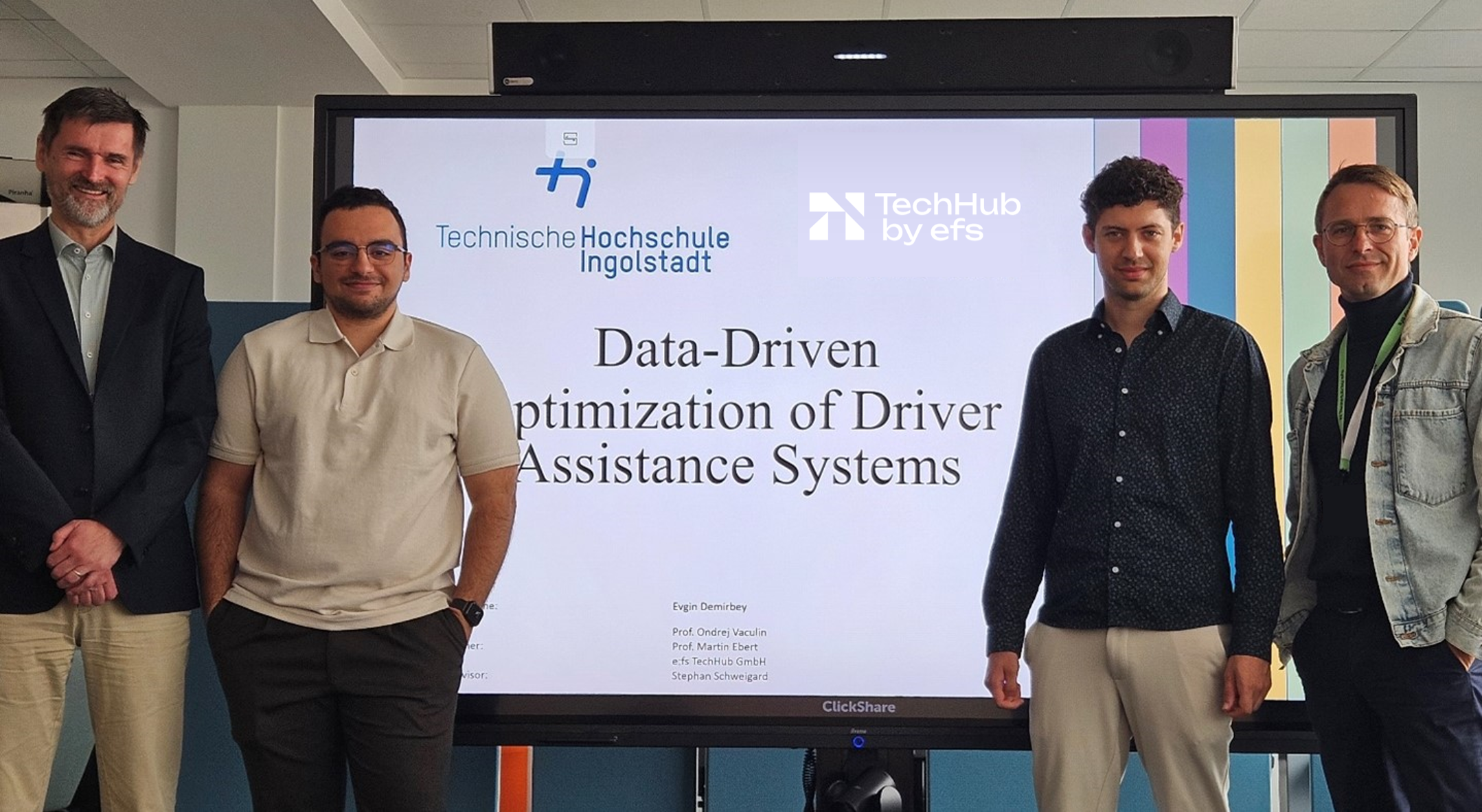
This bachelor’s thesis is the result of close collaboration between the Technical University of Ingolstadt (THI), CARIAD, and TechHub by efs. It exemplifies how academic research and industrial practice come together — applied R&D at its best.
For us, it means not only accompanying innovation but actively shaping it and contributing our expertise as a knowledge partner for future mobility. At the same time, we create an environment where young talents can test their ideas in real projects, gain valuable practical experience, and become part of technological progress themselves.
A special thank-you goes to Stephan Schweigard, Alexander Michel, Ahmet Üstüner, and Clemens Puckelwaldt for their essential support and guidance within our company. We also thank our colleagues at THI and CARIAD whose expertise and support contributed significantly to the success of this work: Ondrej Vaculin, Peter Barth, Sebastian Bayerl, and Johannes Koopmann.
Stay tuned for more updates and exciting events! Follow us on our social media channels so you don’t miss any news.
#innovation #forschung #bachelor #auto #fahrzeugentwicklung #THI #Cariad